Safeload Coverage
The Federal Reserve announced earlier Wednesday it would leave interest rates at 3.5 to 3.75 percentage points with no cuts coming after the two-day March meeting, which is the second time no rates have occurred in 2026. The voting for the monetary policy rate to remain unchanged was 11-1.
Federal Reserve Chair Jerome Powell announced the economic activity has been expanding at a solid pace, job gains have been low, and the unemployment rate has seen little change in recent months. Inflation still remains elevated, and the committee recognized the conflict in the Middle East, and that situation makes the U.S. economy uncertain, he said.
Moving Help® will explain why the Federal Reserve came to this decision, and what it means for homebuyers who are looking to buy or sell a house in the near future.
Who Voted for and Against This Policy Rate?
The Federal Open Market Committee’s vote was 11-1, with 11 members voting for the monetary policy rate to remain unchanged and to leave the target range for the federal funds rate at 3.5 to 3.75 percentage points.
The only dissenting member — Governor Christopher Waller — preferred to lower the target range for federal funds rate by 0.25 percentage points during the March meeting.
Governor Stephen Miran, who dissented in the January 2026 meeting, agreed in the March 2026 meeting to keep the interest rates steady.
| Voting Member Name | How Did They Vote? |
|---|---|
| Jerome H. Powell, chair | Yes |
| John C. Williams, vice chair | Yes |
| Michael S. Barr | Yes |
| Michelle W. Bowman | Yes |
| Lisa D. Cook | Yes |
| Beth M. Hammack | Yes |
| Philip N. Jefferson | Yes |
| Neel Kashkari | Yes |
| Lorie K. Logan | Yes |
| Anna Paulson | Yes |
| Christopher J. Waller | No |
| Stephen I. Miran | Yes |
Why No Cuts to Interest Rates?
The Federal Reserve felt their current stance of keep rates the same was appropriate for maximizing their dual mandate goals of maximum employment and stable prices for the benefit of the American people.
When it came to the labor market, Powell mentioned the Trump administration’s immigration policies and restrictions have sharply reduced the number of available workers, reducing the pace of monthly growth needed to keep the unemployment rate stable.
The Middle East Conflict
This was the first Fed meeting since the United States war in the Middle East with Iran.
Powell also discussed the Middle East conflict. It’s too soon to tell how inflation will work with the uncertainty in the Middle East, Powell said. The Fed is taking a measured tone toward the conflict.
“The implications of developments in the Middle East on the U.S. economy are uncertain,” he said.
Officials are watching the war in the Middle East closely. The Fed is unsure what the effects will be for the U.S. economy from the war.
Oil prices have risen significantly with gas prices on average increasing close to a dollar or more per gallon. Energy prices are expected to push inflation. It’s still too early to know about the war’s full effects, Powell said. He added they’ll have more information during their next meeting.
During the press conference, some reporters mentioned consumers might offset their disposable income to counter higher gas prices by withdrawing from other spending areas. No one knows whether this will be a smaller oil price shock or a larger oil price shock, Powell said.
“We don’t know the duration,” Powell said. “The thing I really want to emphasize is that nobody knows.”
What Does the Future Hold?
The future is a bit cloudy as the U.S. economy will be challenged by the Middle East conflict. On the flip side, Powell noted the U.S. economy is resilient. His example was forecasters had predicted a recession in 2023, but it never came to fruition.
The Fed would like to see inflation come down for good and make sure they’re making progress in those categories.
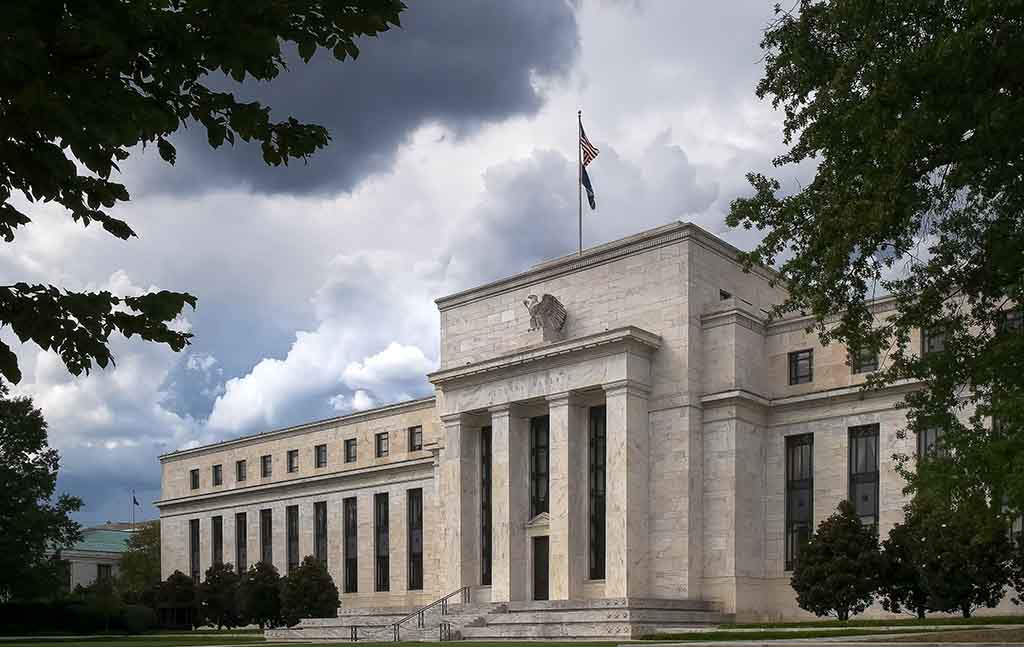
Speaking of inflation, the Fed is well aware of the inflation over the past few years, Powell said. The last few years have had interruptions or “shocks” to the progress the Fed has tried to make.
“We’re well aware of the performance of inflation over the past few years,” Powell said.
Depending on how the situation unfolds for the U.S. economy for the rest of 2026, the Federal Reserve could cut or increase rates. Right now, projections show the Federal Reserve making cuts once in 2026 and only one time in 2027.
The Fed is trying to carefully evaluate its mandates. The problem is maximum employment and stable prices are in conflict with each other, but they aren’t in a bad situation as far as risk.
“It’s not clear at all that one is more at risk than the other,” Powell said. “We are balancing these two goals in a situation where the risks to the labor market are to the downside, which would call for lower rates, and the risks to inflation are to the upside, which would call for higher rates or not cutting anyway.”
What Does This Mean for Home Mortgage Rates?
Because the Federal Reserve didn’t cut interest rates, housing mortgage rates will continue to see similar rates.
Housing mortgage rates won’t see a rapid decline in interest rates. Even without the cut in interest rates, mortgage rates have fallen slightly lower to about the same since the January 2026 meeting. The rates also have been slightly slower since December 2025 as well.
From Jan. 15, 2025, to March 12, 2026, a 30-year mortgage rate has hovered anywhere between 5.98 percent to 6.11 percent for a 30-year mortgage rate, according to Freddie Mac.
During the same time frame, a 15-year mortgage rate has hovered between 5.35 percent to 5.50 percent, according to Freddie Mac. A 15-year mortgage rate has been either steady or slightly lower on a given week when looking at the overall trend since December 2025.
What Does This Mean for People Looking to Move?
Housing mortgage rates are still higher than they were pre-pandemic.
Housing mortgage rates for a 30-year loan and a 15-year loan are still lower than the peak 7.79 percent 30-year mortgage rate and 7.03 percent 15-year mortgage rate in late October 2023.
The market is a buyer’s market at the moment. Some experts are saying it’s a “soft buyer’s market.” Some areas are more competitive than others, however. Affordability remains the largest barrier despite being a buyer’s market, according to Redfin.
Other Federal Reserve News
It was announced just days after the Federal Reserve January 2026 meeting that U.S. President Donald Trump selected Kevin Warsh to succeed Powell. Trump officially nominated Warsh in March 2026.
The nomination is pending at the moment, and Warsh will need Senate confirmation to secure the role. Warsh previously served on the Federal Reserve Board of Governors from 2006 to 2011, according to CNBC.
Reporters at the press conference asked whether Powell would continue to serve as chair if a successor hasn’t been confirmed yet by the end of Powell’s term. Powell said he would serve as “chair pro tem.” Powell’s term ends May 15.
It’s what the law calls, he said. Powell even pointed out it has happened previously, including with him.
Powell’s Future
Before reporters could ask him further questions, he gave a one-time statement about the U.S. Department of Justice’s investigation and whether he’ll continue to serve as a governor after his chair term is over.
For the investigation, he said he has no intention of stepping down until the investigation is “well and truly over.” The investigation is about the central bank’s headquarters and cost overruns for the building renovation along with potential fraud and false statements Powell made to Congress about the costs.
“On the question of whether I will leave while the investigation is ongoing, I have no intention of leaving the board until the investigation is well and truly over with transparency and finality,” he said.
When it came to whether he’ll continue to serve afterward as a governor, he hasn’t made a decision yet. He’ll decide what he thinks is best for the institution and the people they serve. Powell can stay on as a governor until 2028.
“I have not made that decision,” Powell said.
The next Federal Reserve meeting is scheduled for April 28-29, 2026.
More Federal Reserve Articles
- “Federal Reserve: Fed Hold Interest Rates at January Meeting”
- “Federal Reserve: Fed Keeps Interest Rates Steady for 3rd Time in 2026; Powell to Stay on As Governor”
- “Federal Reserve: Kevin Warsh Delivers 1st Press Conference While Fed Rates Remain Same in 2026”
- “Federal Reserve: Fed Leaves Interest Rates Steady Despite Inflation Concerns”
- “Federal Reserve: Fed Raises Rates Unanimously by 0.25%”