Safeload Coverage
When clutter takes over your home, it can feel overwhelming to decide where to begin. Even after you’ve determined what belongings to keep, what do you do with the unwanted items? The Moving Help® Marketplace has a simple, step-by-step guide for how to declutter your home, where to send unwanted items, and how to prevent clutter from returning. Keep reading to take charge of your clutter.
How to Declutter Your Home
Decluttering your home can feel overwhelming. Empower yourself to take control of your mess by following a structure.
With the four steps below, you’ll:
Step 1: Set Goals and Make a Plan
It can be tempting to start decluttering your home immediately. To make the most of the process, however, start by setting goals and making a plan. Ask yourself the questions below to establish reasonable expectations and hold yourself accountable.
Why Do You Want to Declutter Your Home?
You might want to downsize your belongings to make space in your home. Maybe your motives are emotional because your clutter makes you feel overwhelmed.
Knowing your “why” will give you a sense of purpose and direction as you declutter.
How Will You Measure Success?
It’s easy to get carried away with decluttering or, on the flip side, to believe you have made more progress than you truly have.
To avoid this, design metrics for success. For example, “I will be satisfied when I remove five boxes of clutter from the garage,” or “I will have successfully decluttered my home when I can walk into the playroom without feeling overwhelmed by toys.”
What Is Your Timeline?
The decluttering process can feel inherently stressful. To prevent yourself from taking on additional pressure, set realistic expectations based on your lifestyle and schedule constraints.
To hold yourself accountable, set multiple small deadlines for different areas you want to declutter leading up to your final decluttering deadline.
How Will You Hold Yourself Accountable?
Create systems to stay on track. Write your goals in a visible place for a daily reminder or share your goals with friends and family who can check on your progress.
If you’re the only person in your household who doesn’t like clutter, it can be easy to make excuses and fail to meet your goals. To avoid these setbacks, arrange an event for which your area needs to be decluttered.
For example, invite your friends to a dinner party in three weeks, by which your kitchen pantry must be decluttered.
Step 2: Prioritize Where to Start

Begin With Places Where You Can Make a Significant Dent
For example, don’t revisit a recently decluttered box when you initiate your decluttering process. You won’t get rid of more than a couple of items. Meanwhile, you’ll have drained your energy and given yourself a false sense of accomplishment from checking the task off your to-do list.
To Minimize Distractions, Skip the Sentimental Items
Decluttering old mementos can be fun and important, but taking a detour down memory lane can cause you to easily lose sight of your end destination. You’ll waste time and lose motivation that you need for the more grueling decluttering tasks on your list.
The beginning of the decluttering process should be focused and to the point. Once you’ve made sufficient progress in your timeline, there might be an opportunity to have fun and get distracted while decluttering — but not at the start.
When the time comes to decluttering your sentimental items, set a timer and break down the work into manageable pieces — smaller than you think seems necessary. This decreases the chances of an incomplete mess that creates more clutter.
Most importantly, allow yourself to enjoy the process and become a little distracted. At this point, it’s appropriate to reward yourself for the challenging decluttering work you’ve accomplished thus far.
To Declutter Your Home and Your Mind, Tackle Frustrating Areas First
If you’re overwhelmed by the mess and don’t know where to start, consider the frequent pain points in your home. Start somewhere that you can already envision a list of items you want to remove. This ensures steady, manageable progress that can boost your morale when it comes to decluttering your home.
Step 3: Establish the 4 Boxes Technique to Sort Your Belongings
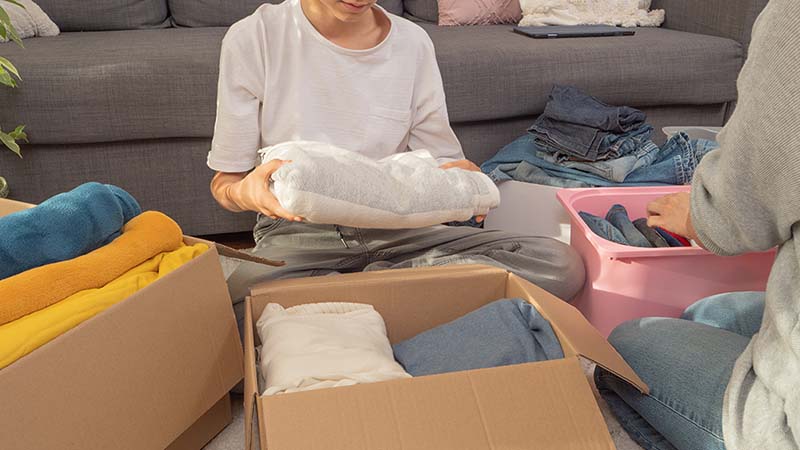
Before diving into decluttering your home, make a plan for organizing your items. A common sorting system is the four boxes technique, where each item falls into one of four categories:
- Keep
- Sell
- Donate
- Trash/Recycle
For the four boxes technique to work, you must clearly define each category. In doing so, consider your personal constraints. For example, what makes something worth selling instead of donating? Consider the effort and cost of listing and shipping items for online sale.
Once you know what type of item falls into each category, keep a cheat sheet handy with category definitions and examples. Writing out your strategy will help you follow a consistent formula for decluttering across all spaces, which is important for staying on track with your goals from Step 1.
To prevent mix-ups, color code your cheat sheet and boxes for easy distinction.
Step 4: Allow Your Space to Get Messier Before It Gets Cleaner
To effectively declutter, start by assessing how much you own. It’s easy to grow complacent about your mess when it’s contained in its natural habitat. To confront your clutter, dump your belongings into one pile on the floor, bed, or table. You’ll gain a new perspective about how much you own and how much you want to clear out.
Where to Send Unwanted Items After Decluttering Your Home
You have four choices on where to send your items after decluttering:
- Keep
- Sell
- Donate
- Trash/recycle
We’ll explore all four options below.
Keep
As you’ll learn at the end of the article, the final phase of decluttering your home is developing organizational systems for your belongings. Success in that final phase relies on thoughtful organization throughout the entire decluttering process. Use subcategories to keep track of the items that you put in the “Keep” box.
For example, put belongings like birth certificates, health records, and passports in an “important files” folder within the “Keep” box. For items you wish to keep that belong elsewhere in the house, create a “To Relocate” box. After you’ve entirely finished decluttering your home, walk a lap around your house with this box and deliver each item to its proper place.
Sell
Online Selling Platforms
Pros: As the seller, you can set your own prices, unlike when selling at a brick-and-mortar resale store.
Cons: You’re often responsible for shipping and packaging. Temporary clutter may accumulate while waiting for a listing to sell.
Platforms:
- Depop — List clothes and accessories.
- Poshmark — List clothes, accessories, and select other items, including home goods and electronics.
- ThredUP — Ship a bag of clothes and accessories for money or credit, and ThredUP takes care of the listing for you.
- Facebook Marketplace and local Facebook selling groups — List any item for either shipping or for in-person pickup only.
Selling In-Person
Pros: Support local resale and consignment businesses without shipping costs.
Cons: A resale may not accept all your belongings, so it’s wise to have a backup plan. Although, this can create more errands. Likewise, you may not sell everything at a yard sale.
Platforms:
- Consignment stores
- Resale stores
- Entertainment exchanges, music stores, or second-hand bookstores
- Yard sale or garage sale
Donate
Nationwide Organizations That Raise Profits for Charity
These nationwide organizations accept donations, sell items at storefronts, and send profits to charity.
Pros: Your donation supports a good cause. With large donation drop-off centers, these organizations don’t turn away most donations. At some organizations, your donation qualifies for a tax write-off.
Cons: Not every organization or location offers front-porch donation pickup, so you must deliver your items. This can be particularly cumbersome for larger items or if your donation center is not nearby.

- Goodwill
- Salvation Army
- Habitat For Humanity ReStore
- Green Drop
- Junior League thrift stores
- Local hospital thrift stores
Donating Goods Directly to Local Community Members in Need
They may not be members of established nonprofit organizations, but many members in your local community will appreciate your donated goods. Consider reaching out to the following organizations in your community to see how you can help. This may require more backend work from you, but it can be a fulfilling way to engage with your community.
Pros: Support your local community and, often, see the tangible impact of your donation.
Cons: Because you may have to go out of your way to create these donation opportunities, errands and communication tasks may accumulate.
- Food pantry (unexpired, unopened food that you aren’t going to eat)
- Community centers or library maker spaces (tools and art supplies)
- Schools and classrooms
- Facebook “Buy Nothing” groups (highly localized to neighborhoods; Someone will always want something)
- Leaving items (typically furniture) on your curb with a “FREE” sign
Trash/Recycle
Ideas for Managing Trash/Recycling
- Throwing waste in your regular trash cycle
- Recycling, when possible
- U-Haul’s “Take A Box, Leave A Box” program for unwanted boxes
- Local scrap metal collectors
- Textile recycling centers
- Local electronics recycling centers
- Sneaker recycling programs (at select shoe stores or online)
- Local school art teachers (egg cartons, jars, scrap fabric and paper): Many art teachers upcycle egg cartons, jars, scrap fabric, and more “waste” into new art projects with students. Before dropping off your goods, always first ask if your donation would be appropriate, acceptable, and appreciated.
Making Changes to Prevent Future Clutter
Decluttering your home is not just getting rid of old clutter; it’s also about developing systems to prevent new clutter from accumulating in the future. This Moving Help guide helps you accomplish those goals.
As you declutter your home, pay attention to patterns. Do you often repurchase items that you didn’t know you already owned? Do you struggle to maintain your existing organizational systems?
Then, consider how to stop these patterns. Would transparent storage bins help you better identify what you already own? Would open storage that’s visible to all — such as cabinets without doors — motivate you to stay tidy?
You’ve made it far in the process of decluttering your home. Now, reward yourself for your hard work by making sure you won’t have to declutter for a long time!